

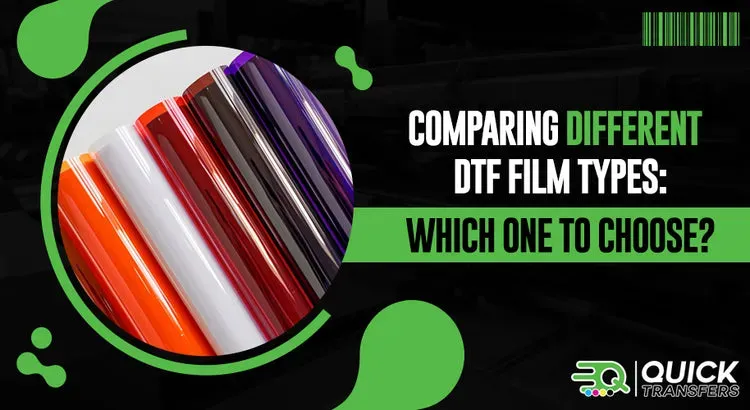
DTF film types PET vs PFP are central to decisions about color, texture, and production efficiency when translating designs to fabric. Understanding the nuances of film performance can help decorators select the right base for their projects and workflows. For many shops, DTF printing pros and cons become part of the decision, as substrate choice affects ink interaction, heat tolerance, and long-term durability. This overview covers the core strengths and limitations of each option, along with practical tips to optimize throughput. With testing, supplier guidance, and clear criteria, you can align your film selection with your design goals and production needs.
Beyond the explicit term DTF film types, the conversation can be reframed around carrier film concepts, substrates, and transfer sheets used in Direct-to-Film processes. LSI-friendly wording suggests considering how the base materials interact with inks, primers, and adhesives across cotton, blends, and synthetic fabrics. Alternative phrasing like ‘transfer film substrate’ or ‘film base’ helps capture related signals while maintaining clarity for readers. Understanding these related terms can guide you when comparing options and communicating with suppliers, printers, and garment decorators.
DTF Film Types Uncovered: PET vs PFP and How That Shapes Results
DTF film types shape every aspect of the transfer—from color vibrancy to texture and long-term durability. When we consider DTF film types PET vs PFP, the choice directly influences how inks interact with the substrate, how the transfer adheres to fabrics, and how the finished garment will feel after curing. Reading the landscape of film bases through this lens helps decoraters anticipate performance differences across common fabrics like cotton blends and poly blends. This understanding also guides expectations for wash durability and edge definition over multiple wears.
DTF transfer film comparison becomes a practical exercise when selecting the right base for a given project. By examining how PET and PFP respond to the same inks and primers, printers can predict outcomes in color fidelity, edge sharpness, and the texture of the hand feel. The goal is to identify which film type aligns with your production goals, whether that means the highest detail for photo-realistic designs or reliable performance for high-volume runs.
PET DTF Film Advantages: Clarity, Stability, and Performance
PET DTF film advantages are most evident in image sharpness, color accuracy, and dimensional stability. PET’s optical clarity supports crisp detail and faithful reproduction of fine lines, gradients, and small text, which is especially important for photo-realistic designs on apparel. Its dimensional stability helps prevent warping during heat application, keeping designs aligned on garments with varying sizes and shapes.
Beyond sharpness, PET film’s heat resistance contributes to consistent results across a range of curing temperatures and dwell times. While PET can be more costly and less abundantly available in some markets, its reliability makes it a preferred choice for printers who prioritize repeatable color density and edge integrity in high-detail prints.
PFP DTF Film Drawbacks and Suitability for Specific Projects
PFP DTF film drawbacks often center on consistency and long-term endurance. Some printers report variability in color reproduction and edge clarity compared with PET-based films, particularly across batches. Availability and regional support can also be less predictable for PFP, which can complicate supply chains and lead times for production planning.
Despite these drawbacks, PFP can still make sense in specific contexts—especially when cost considerations or particular handling characteristics align with production needs. For example, certain presses and workflows may benefit from PFP’s glide or release properties, or its lower material cost per transfer at scale. In such cases, a careful testing phase can determine whether PFP’s trade-offs are acceptable for a given design portfolio.
DTF Printing Pros and Cons in Practice: Film Choice and Outcome
DTF printing pros and cons extend beyond film choice to include the overall workflow, ink chemistry, and post-transfer testing. The method enables full-color prints with a soft hand feel, good stretch, and broad fabric compatibility, making it attractive for small runs and on-demand production. However, achieving consistent results requires precise film handling, accurate ink curing, and rigorous wash testing to ensure durability.
Film choice affects outcomes as much as any other variable. A thoughtful evaluation—considering factors like color fidelity, durability under repeated wash cycles, and production economics—helps balance the strengths of PET, PFP, or a mixed approach. When combined with careful press settings and standardized testing, this approach supports better batch-to-batch consistency and predictable performance.
DTF Transfer Film Comparison: How to Choose Between PET and PFP for Your Fabrics
A structured approach to the DTF transfer film comparison starts with defining project goals and fabric tests. Decide whether you prioritize maximum color vibrancy, edge definition, or cost efficiency per garment. Then test across your most common fabrics (cotton, blends, darks, lights) to observe color fidelity, edge clarity, and texture in real-world conditions.
Finally, evaluate long-term performance with wash tests and durability checks. Document all variables—ink sets, primers, curing temperatures, and dwell times—to build a decision-making knowledge base. The result is a data-driven path to selecting PET, PFP, or a mix that aligns with your production goals, rather than relying on assumptions or supplier hype.
Frequently Asked Questions
DTF film types PET vs PFP: what are the key differences and how do they impact color, durability, and production efficiency?
PET film types offer clarity, dimensional stability, and heat resistance, which support precise color reproduction and sharp details. PFP film types can reduce material costs and offer different handling characteristics, but may show less consistent vibrancy and edge clarity across batches. For high-detail or long-running projects, PET is usually the safer default; for cost-driven, high-volume runs, a tested PFP option can be viable after side-by-side testing.
PET DTF film advantages: why choose PET for transfers?
PET DTF film advantages include exceptional clarity, sharp edges, and strong dimensional stability that maintain color accuracy and detail during transfer. It also handles heat well, reducing the risk of warping or blurring on diverse fabrics. While PET can be more costly and require careful tension control on press, its reliability makes it a preferred choice for demanding designs.
PFP DTF film drawbacks: what are the trade-offs?
PFP DTF film drawbacks often include potential variability in color consistency and edge sharpness compared with PET, especially across batches. Availability and regional support for PFP can be more limited, affecting lead times and troubleshooting. Long-term durability, such as color fastness after multiple washes, may also be more variable depending on the ink, primer, and process.
DTF printing pros and cons: how do film choices affect outcomes?
DTF printing pros include full-color prints, soft hand feel, and good stretch across fabrics, with straightforward workflows for small runs. DTF printing cons involve the need for precise film handling, ink-curing, and thorough wash testing to ensure durability. Results can be sensitive to ink formulas, primers, transfer temperatures, and batch-to-batch variation, so consistent testing is essential.
DTF transfer film comparison: how should PET and PFP influence your choice across fabrics and production scales?
In a DTF transfer film comparison, PET generally delivers crisper details and stronger color density on cotton and blends, while PFP can offer lower material cost for high-volume runs. The choice often comes down to balancing color fidelity and durability against cost and supplier support, so run side-by-side tests on your most-used fabrics. Also consider lead times, availability, and the press compatibility from your film supplier.
| Aspect | PET film | PFP film |
|---|---|---|
| Clarity and color accuracy | Sharpness and color accuracy; maintains fine details | Results may vary with inks and primers; may differ in edge sharpness |
| Dimensional stability and warping | High dimensional stability; resists warping during heat | Variable warping and handling depending on batch |
| Heat durability | Withstands typical transfer heat and dwell times | Durability depends on formulation; can vary |
| Cost and availability | Generally higher cost; broad supplier networks | Often lower material cost; availability can be region dependent |
| Handling on press | Requires tension control to prevent curl | Glide and release properties can differ; workflow impact |
| Ink compatibility and white opacity | Consistent with many inks; strong white opacity on dark fabrics | May interact differently with ink sets; results vary |
| Consistency and vibrancy | Often more consistent color reproduction and edge sharpness | Vibrancy and consistency can vary by batch or setup |
| Long term durability | Reliable wash fastness across multiple cycles | Durability can vary with fabric and wash testing |
| Texture and fabric compatibility | Crisp finish on cotton and blends | May offer different tactile properties and suit certain fabrics |
| Availability and support | Broad supplier networks and ongoing support | Regional availability and guidance may be limited |
Summary
DTF film types influence every decision a garment decorator makes, and understanding PET vs PFP helps balance color fidelity, texture, durability, and workflow. PET film offers crisp detail, strong color density, and excellent heat resistance, along with broad availability and proven wash durability, making it a dependable default for high-precision work. PFP film can lower material costs and offer different handling characteristics, but its consistency, vibrancy, and long-term durability may vary with ink, primer chemistry, and regional support. When choosing, consider the target fabrics, design complexity, production volume, and total cost per transfer. Run side by side tests, wash proofs, and production scale trials to understand how each film behaves under your processes. In the end, selecting between DTF film types comes down to your specific project needs, fabric mix, and a disciplined testing phase that leads to reliable, repeatable results.